

Veejay Madhavan doesn’t talk like a disruptor. He speaks with the calm precision of someone who’s spent decades in executive boardrooms. And walked away by choice.
What he’s building now isn’t a startup or a consultancy in the traditional sense. It’s a response to a quiet crisis in leadership.
After 26 years in senior corporate roles, Madhavan is betting the future of work on two forces many companies still fail to understand: Gen Z and AI. He’s not chasing trends. He’s mapping blind spots, especially the ones no one at the top wants to talk about.
The Pivot Point: From Executive to Architect of the Future
Before launching OulbyZ, Veejay Madhavan had already built a legacy. With more than two decades of boardroom experience across ASEAN, India, and the Middle East, he was known for driving growth through strategic clarity and people-first leadership.
But by 2017, something had shifted. He found himself drawn to a generation that many of his peers dismissed. The Gen Z.
The pandemic gave him time to reflect. While on a break from corporate life, he spent more time with his daughter, a Gen Z student. Their conversations raised questions that were personal.
What kind of world would she enter as a young professional? Would the workplace be ready for her? Would she be ready for it?
It wasn’t just parental concern. Madhavan saw a widening gap between how companies viewed Gen Z and what the generation actually had to offer. Instead of writing it off, he made it his mission.
He founded OulbyZ to address what he calls “a missing bridge” between generations, and enrolled in a doctoral program to formally research Gen Z and the impact of AI on the workforce. It was a deliberate pivot from corporate strategist to workforce architect, building solutions for a future that wasn’t hypothetical anymore.
Gen Z: Not a Problem to Solve, But a Generation to Understand
Ask Veejay Madhavan about Gen Z, and he won’t offer stereotypes.
He’ll describe a generation that’s curious, inventive, and already more entrepreneurial than many give them credit for. He’s worked closely with Gen Z for years and resists the common impulse to “fix” them.
“They’re not rough diamonds,” he says. “They’re unpolished gemstones.” The distinction matters. Calling someone a rough diamond implies they have no form until someone chisels it out of them.
Madhavan sees Gen Z differently; they have shape, potential, and clarity, but lack the conditions to shine in traditional corporate environments.
What they bring to the table—adaptability, a native grasp of technology, and a willingness to experiment—often goes unseen by older leadership. What they lack—formal AI training, corporate communication skills, and fluency in hierarchical work structures—can be taught.
But only if companies are willing to change, too.
He doesn’t place the burden entirely on young professionals to adapt. Instead, he urges leaders to create systems that speak Gen Z’s language: clearer feedback, flexible structures, and more meaningful mentorship.
The tools exist. What’s missing, he says, is the will to use them well.
The Leadership Disconnect: Blind Spots at the Top
For all the talk about innovation and future-readiness, Veejay Madhavan has seen too many companies skip the most basic question: Do our people have what it takes to deliver what we’re asking for?
That’s the blind spot he keeps coming back to. In strategy rooms, goals are reverse-engineered from KPIs. Financial models are polished.
Operating structures get reworked. But conversations about human capability—what people are actually equipped to do—often come too late, if at all.
Nowhere is that disconnect more visible than in how companies approach AI. Many rush in, afraid of being left behind, without first considering who will be responsible for making those tools work.
“People talk about AI like it’s a plug-and-play fix,” Madhavan says. “But the hard part is never the tech—it’s the team.”
He also challenges the illusion of control that sits at the heart of traditional leadership. To run fast-moving, collaborative teams, he argues, leaders need to give some of that control up.
That doesn’t mean lowering standards. It means building systems where people are trusted to make decisions, held accountable, and supported when they fail.
The old model of command-and-control doesn’t hold up in this context. Leaders need to know when to guide from the front and when to step back. Coaching, mentoring, and active listening aren’t soft skills, he says. They’re survival skills.
Purpose Isn’t a Poster: Why Gen Z Walks Away
Spend time with Veejay Madhavan and one point becomes impossible to ignore: for Gen Z, purpose isn’t a buzzword. It’s a filter.
In his research and advisory work, he’s seen a shift that extends beyond Gen Z to millennials and even Gen X. People are no longer content with surface-level mission statements or splashy recruitment videos.
They want to see purpose embedded in real decisions: how companies treat people, how leaders behave when no one’s watching, and whether values hold up when profits are at risk.
For Gen Z, it’s non-negotiable. They’re not just vetting companies; they’re investigating managers.
“After an interview, they’ll ask their networks what that person’s like in real life,” Madhavan explains. “If the leadership doesn’t align with their values, they’re out—regardless of the paycheck.”
This isn’t entitlement. It’s discernment shaped by a generation that grew up with access, exposure, and options. Madhavan argues that Gen Z isn’t rejecting work—they’re rejecting inauthenticity.
And unless organizations understand that, they’ll keep misreading silence as disinterest, when it’s really just withdrawal from something that doesn’t feel real.
Purpose, he says, can’t live on a wall. It has to show up in hiring, feedback, product decisions, and even exits. Otherwise, it’s just branding. And Gen Z knows the difference.
ALSO READ: Career Catfishing: Gen Z Ghosts Employers as a Power Statement
The AI Dilemma: Ethics, Bias, and the Myth of Objectivity
Veejay Madhavan doesn’t buy the idea that AI is neutral. In theory, algorithms promise fairness. In practice, they mirror the systems that train them—biases, blind spots, and all.
“Garbage in, garbage out,” he says. “And sometimes, it’s not just garbage. It’s malice.” He’s seen what happens when organizations feed flawed or fragmented data into AI tools, especially in performance management systems. What results isn’t insight. It’s distortion.
His focus is on explainability. If employees don’t understand how AI influences decisions—who gets promoted, who’s underperforming, who gets a raise—it becomes a black box. And when things feel arbitrary, trust breaks down fast.
He’s also skeptical of standardized evaluation models. “The bell curve doesn’t reflect reality,” he says. “Why should every team have the same ratio of top performers? Why can’t we reward excellence where it actually shows up?”
In his view, AI should support fairness, not obscure it. It should give managers more clarity over time, not just amplify their most recent impressions. Done right, it becomes a tool for memory, feedback, and growth. Done wrong, it becomes a convenient scapegoat.
At its best, AI doesn’t replace the human element. It reveals whether a culture is ready to be honest about how people are valued—and why.
Simulation Labs and the Learning Gap
In Veejay Madhavan’s view, there’s a disconnect between what universities think they’re preparing students for and what companies actually need. He’s seen both sides say, “We’ve done our part,” while the skills gap widens.
His response? Bring back the simulation lab; not as a gimmick but as a pressure-tested learning model.
In his version, students don’t just sit through lectures. They’re dropped into corporate decision-making scenarios where every choice has consequences—on revenue, morale, and team retention. Every day simulates a year. Every curveball, a live challenge.
The exercise forces Gen Z participants to move beyond theory. They grapple with trade-offs, explain decisions to an executive board, and reflect on their blind spots. The goal isn’t perfection. It’s clarity.
“They see the iceberg, not just the tip,” Madhavan says. “And they start to understand what it really takes to lead.”
It also gives them a better sense of their own value. When asked about their skills in job interviews, they no longer reach for buzzwords. They speak from experience.
Still, Madhavan knows implementation won’t be easy. While companies are increasingly open to the concept, some academic institutions resist anything that doesn’t come with a formal certificate.
But for him, the takeaway is simple: real learning doesn’t always look official. It looks like ownership.
Context Matters: Why Gen Z Isn’t One-Size-Fits-All
Veejay Madhavan has spent enough time across borders to know that Gen Z doesn’t behave the same way everywhere. Culture, context, and even parenting shape the way young professionals enter the workforce, as well as what they expect when they get there.
A Gen Z in the U.S. might question the value of a degree, pick up skills through online courses, and move out at 18.
In parts of Asia, that same generation might still see university as a non-negotiable step, with career choices narrowed to a shortlist approved by family tradition. Even independence is negotiated differently; leaving home too soon can be seen as disrespect, not growth.
These differences aren’t surface-level. They influence how Gen Z responds to failure, feedback, and authority.
In more conservative settings, speaking up might feel risky. In others, it’s encouraged. So when Madhavan designs programs for organizations, he doesn’t begin with generational labels. He begins with context.
Whether he’s working with leaders in ASEAN, the Middle East, or the West, his process starts the same way: understand the organization’s current culture, map its readiness for change, and tailor interventions accordingly.
What works in one office might fall flat in another—and that’s not a flaw. It’s a fact.
“The conversation always starts with where you are,” he says. “Not where you think you should be.”
Clarity, Curiosity, and the Real Work Ahead
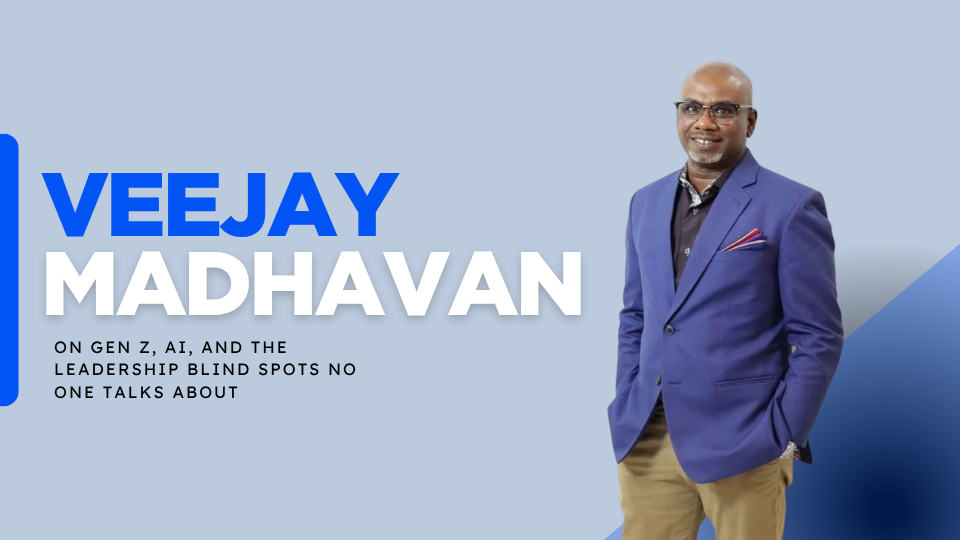
For Veejay Madhavan, curiosity is a survival skill. He’s spent the last several years helping leaders and teams see what they’ve been trained to overlook—how fast the world is changing, and how little of it can be solved with old instincts.
His message to Gen Z is direct: Other people’s opinions of you aren’t reality. Your ideas are valid. Stay curious. Keep asking questions no one’s ready to answer yet.
To corporate leaders, he offers something harder: Stop trying to prove yourself. Learn to listen—without judgment, without rushing to direct.
The skills that will define tomorrow’s best leaders aren’t technical. They’re relational. Coaching without ego. Feedback without hierarchy. Awareness without defensiveness.
What gives him hope is possibility. “If you look past the noise, there’s a lot still waiting to be built,” he says. “But you have to be willing to do the real work. Not just fix what’s broken, but create what’s missing.”
He doesn’t see his role as a fixer. He sees it as a builder. “I’m not here to patch wounds,” he says. “I’m here to help companies build new muscles.”
EDITOR’S NOTE: This feature article is based primarily on Veejay Madhavan’s interview with TheoSym founder Sam Sammane, along with publicly available biographical information. Some quotes have been lightly paraphrased for clarity and readability.


